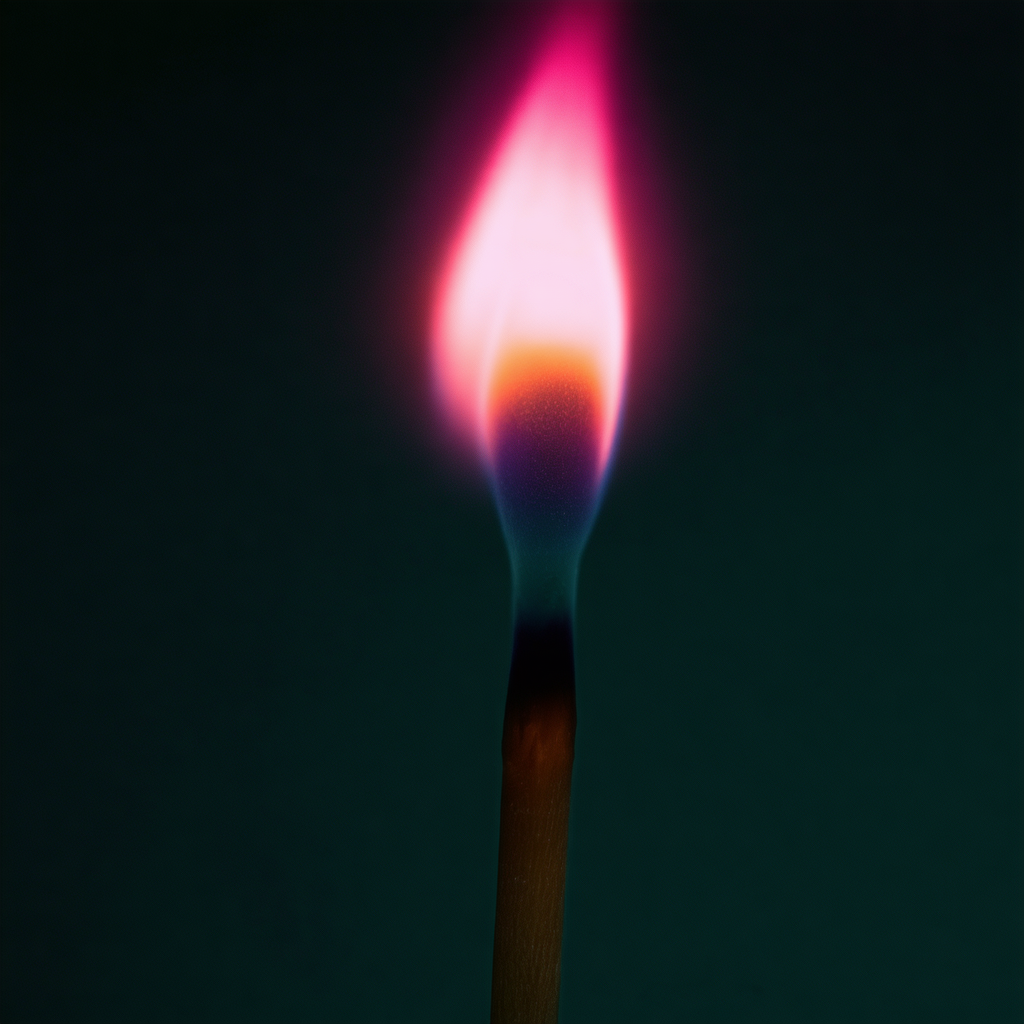
Fire sound effects
Fire is a mix of crackle and roar. The prompt sets the ratio between them.
Listen: 10 samples from the fire collection
Every clip shows the exact prompt that produced it. The render script reads its prompts from the same file as this page. Copy one, change a word and generate your own.
Wildfire
via audiocpp-stable-audio-3-sfxforest wildfire, roaring flames with trees cracking and popping, huge and enveloping, outdoor
Gas stove
via audiocpp-stable-audio-3-sfxgas stove igniting, clicking piezo sparker then a soft whump as the ring lights and settles to a hum
Candle out
via audiocpp-stable-audio-3-sfxsingle candle flame flickering then blown out with a soft puff and a wisp of smoke, close mic, quiet room
Flamethrower
via audiocpp-stable-audio-3-sfxflamethrower firing a sustained burst, pressurised fuel roaring into open flame, outdoor and wide
Embers
via audiocpp-stable-audio-3-sfxdying campfire embers ticking and settling, occasional soft pop, quiet night outdoors
Burning fuse
via audiocpp-stable-audio-3-sfxburning fuse cord, fizzing sparks travelling steadily along, close mic, dry
Fireball whoosh
via audiocpp-stable-audio-3-sfxlarge fireball erupting, deep air-sucking whoosh into a roaring flame burst with a crackling tail
Paper burning
via audiocpp-stable-audio-3-sfxsheet of paper catching and burning, crisp crackling with curling and a light ash collapse, close mic
Torch loop
via audiocpp-stable-audio-3-sfxburning torch held in hand, steady flame flutter with an occasional flare, stone corridor, seamless loop
Structure collapse
via audiocpp-stable-audio-3-sfxburning building collapsing, roaring flames with timber cracking and heavy debris falling
Prompts that work
These models respond to physical description. Name the material, the action and the space.
Campfire bed
small campfire burning, steady wood crackle and pop, low warm hiss, outdoor, 4 seconds, loopable
"Steady" and "loopable" push the ratio toward mostly crackle with a low, near-constant hiss underneath, like a fire burning at a steady rate.
Ignition
torch bursting into flame, sudden whoosh ignition then settling into a steady flicker, 2 seconds
Naming two phases (the ignition whoosh, then the settle) gives one generation a believable start.
Match strike
single wooden match struck and igniting, sharp scrape then a quick flare hiss, close mic, dry
"Sharp scrape" is the friction before there is any fire. Without it the flame appears from nowhere.
Big blaze
large structure fire, dominant roaring flame body, occasional sharp pops from burning debris, 3 seconds
"Dominant roaring flame body" tips the crackle-to-roar ratio toward roar. That ratio is the difference between a campfire and an inferno.
Flare-up
sudden fire flare-up from a fuel splash, sharp whoosh burst, brief roar, then fading crackle, 2 seconds
Naming the cause ("fuel splash") gets the sharp whoosh burst of a real flare-up.
Making fire sounds that fit
Set the crackle-to-roar ratio
Every fire sound mixes two components: crackle, the discrete pops of wood or debris burning, and roar, the continuous rush of the flame pulling in air. A campfire is mostly crackle with a thin hiss underneath. A large structure fire is mostly roar with occasional sharp pops from things collapsing. Decide the ratio before you write the prompt, for example "steady wood crackle and pop" or "dominant roaring flame body". The ratio defines the fire.
Prompt ignition as its own event
A fire starting has its own shape: a scrape or whoosh, then a flare, then a settle into steady burning. For a fire coming to life, describe that arc ("bursting into flame... then settling"). "Fire starting" alone tends to render as a generic crackle with no attack.
Scale changes texture
Larger fires shift the balance toward low-frequency roar and add irregular debris pops that small fires lack, so a match, a torch, a campfire and a structure fire are different sounds. Name the fuel and scale ("single wooden match", "large structure fire") instead of using volume words. The model uses different textures at different scales.
Why generate locally
The models run on your machine, which changes the cost, the privacy and what you can automate.
Offline after download
Weights are fetched once. After that, generation, the library and the API all work with the network off. Everything lives in one SQLite file and one folder of WAVs under ~/.soundbox, and nothing is uploaded.
Your agent can use it
Soundbox runs an MCP server in the same process, with tools for generating and listing sounds. Generated files come back as absolute paths, so an agent can copy them into a project.
Licences stated up front
Every model's terms are shown before you download it, and non-commercial weights need an explicit confirmation. Soundbox is MIT. The licence of the model that made a sound governs what you may do with it.
claude mcp add --transport http soundbox http://127.0.0.1:17494/mcpcurl -X POST http://127.0.0.1:17494/api/generate \
-H 'Content-Type: application/json' \
-d '{"model":"audiocpp-stable-audio-3-sfx","prompt":"8-bit coin pickup blip","duration_s":1}'Frequently asked questions
- Can I use these sounds in a commercial video or game?
- It depends on the model that made them. Soundbox shows each model's licence before you download its weights. The Stable Audio 3 models use the Stability AI Community License: commercial use is free below USD $1M annual revenue, and above that Stability requires an enterprise licence. ACE-Step 1.5 is MIT. MiniMax's models allow commercial use under a revenue cap and require an attribution notice. Some voice and stem-separation models are non-commercial only. Soundbox itself is MIT, but the audio is governed by the licence of the model that made it. Read that licence before you ship; this summary is not legal advice.
- Does this run offline?
- Yes, once the weights are downloaded. Soundbox runs the models locally and stores everything in one SQLite file and one folder of WAVs under ~/.soundbox. There is no account, API key or upload step. Only the initial model download needs the network.
- What hardware do I need?
- An NVIDIA GPU with 8 GB or more. CPU-only is supported, but each generation then takes minutes. That is fine for a few short clips and slow for a large batch.
- Can my coding agent generate these for me?
- Yes. While Soundbox is running it serves MCP at http://127.0.0.1:17494/mcp, with tools for generating and listing sounds. An agent can generate a sound as part of the task it is already doing and gets back an absolute file path to use in your project.
- How is this different from downloading a sample pack?
- A pack gives you one fixed crackle-to-roar ratio at one scale, and you accept it or layer clips to fake the size you need. Generating lets you set the ratio and the fuel (a match, a campfire, a blaze) and generate the ignition separately from the sustained burn. It costs time and a GPU.