Anthony Saviano
What audio.cpp replaced
Adding a model used to mean a research repo, a CUDA wheel and a torch pin that fought the last one. Now it is an id, a repo and a few defaults.

If you have ever tried to run two open-weight audio models on one machine, you
know the shape of the afternoon: two repos, two requirements.txt, two
opinions about which torch build is the correct one. In Soundbox every model
goes through one native binary, and adding a model is a catalogue entry rather
than an environment.
This post is about what that ritual cost, what replaced it, and two install decisions with named failure modes. It does not cover why only one model stays resident in VRAM (that is one model at a time), driving any of this from an agent (that is point your agent at Soundbox), or which model is best at what.
The two shapes a model can have
docs/AUDIOCPP.md puts the whole argument in two sentences. A model that runs through audio.cpp is a catalogue entry: an id, a repo, a few defaults. A model that does not is a Python stack with its own torch pin, which sooner or later cannot coexist with the others and needs a sidecar process to keep the peace.
Everything below is what it costs to be on the wrong side of that line.
What the ritual actually was
The README says it plainly: there are excellent open-weight text-to-audio models, and every one of them ships as a research repo — clone this, pin that CUDA wheel, write your own inference script, discover the licence afterwards. Four steps, and the fourth is the one you do last and should have done first.
That is not a criticism of the repos. Their job is to make a paper reproducible on the machine the paper was written on; the job they are not doing is being one of six things installed side by side on yours.
Model A wants a torch built against one CUDA runtime, model B wants a different one, and pip will hand you the second while silently breaking the first — which you discover at generation time. The usual fix is a virtualenv per model and a process to talk to each one over a socket, every sidecar with its own startup time, its own crash and its own thing to supervise. You wanted a sound effect and you have acquired a service mesh.
What replaced it
audio.cpp is a ggml-based C++ runtime that implements 50+ audio model families behind a single CLI, with CUDA, HIP, Metal, Vulkan and CPU backends, and no Python in the inference path. That last clause is the one that does the work: there is no torch to pin, because there is no torch.
Soundbox's base install contains no model runtimes at all — Node 20+, npm install, and no GPU-specific wheel to match against your hardware. The backend
is detected per machine (Metal on Apple silicon, CUDA where nvidia-smi
answers, Vulkan or CPU otherwise) and that decides which release asset gets
downloaded. Above the binary there is no Python either: the server is
TypeScript on Node — Fastify, with the MCP server mounted in the same process.
Nothing above the binary ever sees a tensor.
The docs took longer to agree than the code did: while this post was being
drafted they still promised Python in three places — a dead backend/
directory, a FastAPI server, and a uv pip install for a package that cannot
be installed — all three now corrected.
The scepticism this deserves is "no Python" as marketing versus as fact, so here it is in a form you can check without installing anything — the CLI runs with no server and no web app up:
soundbox pull audiocpp-stable-audio-3-sfx
soundbox run  audiocpp-stable-audio-3-sfx "glass breaking on concrete" --out test.wav
That is one process, writing a WAV. If a sidecar were hiding in there, this is where you would find it.
Adding a model is a JSON edit
The catalogue lives in audiocpp_models_catalog.json. Adding or correcting a
model means editing it — no new dependency, no new environment and no new code,
because every model drives through the same adapter. It does not even have to
be our JSON: anything in <data dir>/models/custom.json is loaded alongside
the shipped catalogue in the same shape, so your own quantisation of your own
finetune is a file you write, not a fork you maintain.
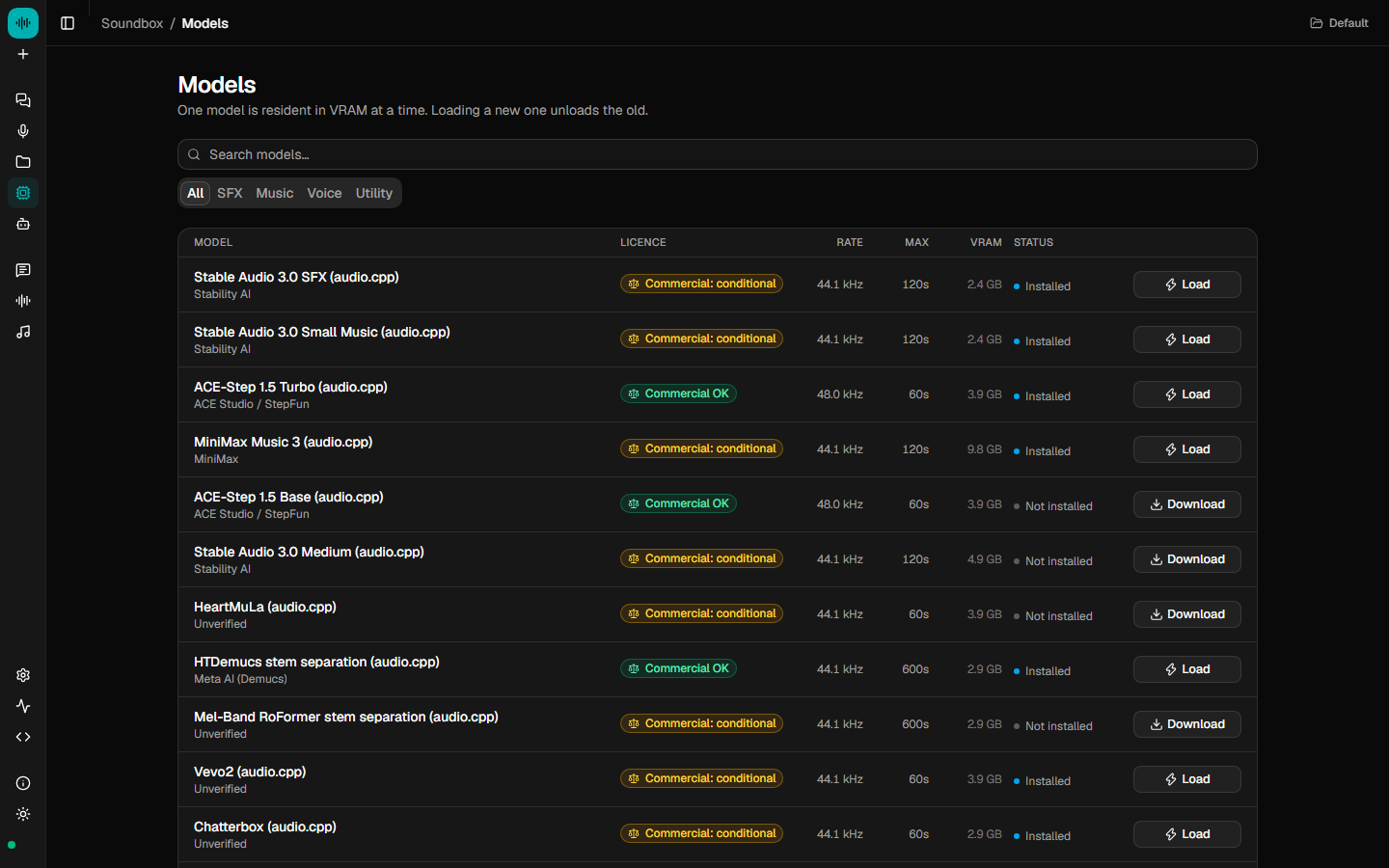
Listed models appear in the picker. Extras are catalogued but hidden
until you enable them on the Models page, and enabling one adds it to
GET /api/models immediately — same code path, no restart. Being data rather
than code is what makes that possible.
Two install decisions with named failure modes
Soundbox ships no native binaries and vendors none. audiocpp_cli is fetched
from upstream GitHub releases the first time you ask for it and cached under
your data directory, not inside the checkout.
Vendoring it was the obvious alternative, and it loses twice. A vendored binary makes every clone carry a runtime most contributors will not run, and it has to be a build that works everywhere — which means the lowest common denominator, which means CPU. Fetching on demand gets the asset that matches your machine's backend instead. Downloads are checksum-verified where the release publishes a manifest; where it omits your platform, the installer warns and installs anyway, because refusing there would make the automatic path less reliable than the manual download it replaces.
Letting PATH win was the other one. When Soundbox needs the binary it
checks an explicit SOUNDBOX_AUDIOCPP_BIN override first, then the managed
install under <data dir>/bin/, then PATH. The managed install comes before
PATH deliberately: someone who has just run the installer should get what
they installed, not a stray system-wide copy from a brew install they made
months ago and have entirely forgotten about. soundbox model status audiocpp
reports which one it resolved and how.
The caching follows the same instinct. Runtimes live in bin/ beside
models/ rather than inside it, and each version gets its own directory, so an
upgrade never half-overwrites the copy you are running and reinstalling the
engine does not cost you your weights.
What this does not fix
It does not fix licensing. Every model shows its licence before you download it, and several of the good ones forbid commercial use — open weights and permission to sell what they make are separate questions, and some of these models answer the second one with no.
It does not make anything fast. CPU works and CPU takes minutes; an 8 GB NVIDIA
GPU is the realistic requirement, and a generation far slower than you expected
is almost always a silent fall back to CPU that soundbox model status audiocpp will tell you about.
And it does not mean every catalogue entry has been run. One model is verified end to end and the rest are untested — that is what the Status column says, and a uniform install path is the thing that makes working through the list cheap rather than an excuse for the column reading the way it does.
The claim is narrower than "no Python" sounds, and more useful: the cost of supporting one more model is a few lines of JSON instead of an environment that has to be negotiated with the last one.